Moderate-to-Severe Adolescent Scoliosis
How this case presented:
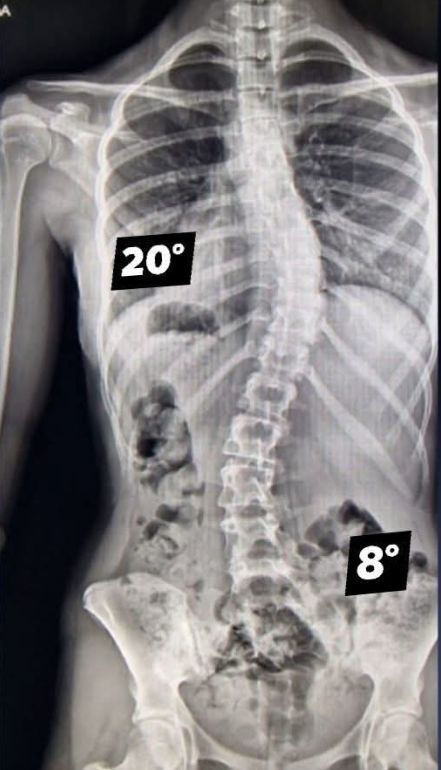
A moderate-to-severe thoracolumbar scoliosis identified during an active growth phase, where the risk of curve progression is higher.
Curve measure (Cobb angle):
46° initially → 28° at 2-year follow-up.
Where:
Thoracolumbar spine (mid-to-lower back).
Daily life:
Postural asymmetry and trunk imbalance during growth, requiring structured long-term management.
Previous strategies:
This required more than a short course of exercises, management needed a long-term plan, consistent follow-up, and disciplined home practice.
Scroll


What the assessment focused on:
-
Progression risk during growth
-
Trunk symmetry, rotation control, and mobility
-
Breathing mechanics and rib expansion
-
Progression based on response over time
Clinical approach:
A structured 2-year programme using 3D rehab principles and corrective exercise, with regular supervision and brace guidance where indicated.
Outcome:
Cobb angle reduced from 46° to 28°, with improved posture, symmetry, mobility, and breathing mechanics (in this case).
*Outcomes vary depending on curve type, skeletal maturity, and adherence. This case is shared for education and context, not diagnosis.
Key Takeaways
Disc-related radicular pain is managed best through accurate assessment, controlled progression, and long-term consistency, not quick fixes.
Acute phase needs control, not intensity
Early management focuses on settling irritation, reducing provocation, and restoring basic tolerance before strength work becomes effective
Progression is guided by symptoms and function
Loading is increased only when the body shows improved tolerance, based on neurological signs, symptom behaviour, and functional capacity.
Return-to-work demands must be trained results
For high-demand roles, rehab must rebuild tolerance for sustained posture, standing, and workload, not just “being pain-free”.
Imaging supports the picture, but doesn’t lead it
MRI findings are interpreted alongside clinical presentation. Symptoms and function guide decision-making and progression.
Clinical Insight
In cases with motor deficit, rehab isn’t about chasing pain relief, it’s about restoring motor control under safe, progressive load. Consistent reassessment and precise progression are what rebuild function over time.
Contact Me
The easiest way to reach me is on Instagram. I personally read and reply to messages. Based in Chelsea and Edgware, London.
*Instagram messages are used to understand your enquiry and determine whether an appointment is appropriate before booking.
No medical advice or diagnosis is provided via social media.